SERMON ~ 08/15/2021 ~ Living Bread

08/15/2021 ~ Proper 15 ~ Twentieth Sunday in Ordinary Time ~ Twelfth Sunday after Pentecost ~ 1 Kings 2:10-12; 3:3-14 ~ Psalm 111 ~ Proverbs 9:1-6 ~ Psalm 34:9-14 ~ Ephesians 5:15-20 ~ John 6:51-58 ~ VIDEO OF SERVICE ON YOUTUBE:
https://www.youtube.com/watch?v=zEUnIOMl0KU

Living Bread


“I am the living bread that came down from heaven. Whoever eats of this bread will live forever; and the bread that I will give for the life of the world is my flesh.” — John 6:51.

I was nineteen when my grandfather, my father’s father, died in 1967. He finally succumbed to a series of strokes which left him weaker and weaker over the course of several years.

For reasons of which I am now unsure— perhaps they are mired in the murky fog of childhood memories— my grandfather and I had a special bond. While I can’t quite put a finger on how to describe that bond, I can safely state we had the same sense of humor— sometimes silly and physical— sometimes dry, verbal, intellectual.

An early interaction I do remember happened when I was, perhaps, five. One evening when visiting his home, I had a quiet tantrum. I curled up in an easy chair and, pretending to be asleep, refused to come to the dinner table when called.

Always a small, short, thin man, Grandpop was a little taller than five feet and probably weighed all of 110 pounds soaking wet. But he was strong.

He had been a sanitation worker when that meant picking up iron trash cans and lifting them into garbage trucks. Since I had curled up on a chair in a juvenile snit and everyone had waited way too long for my presence at the dinner table, Grandpop came to me, gently lifted me out of the chair, cradled me tenderly in his arms, carried me into the dinning room and sat me where I belonged. (Slight pause.)

By the time I was in my teens I outweighed him and towered over him by a considerable amount. By that time, he was living with my family. That’s when the strokes began to happen.

Typically, he would be sitting in his reclining chair in the living room, reading, invariably smoking an ever-present cigar, and start to have convulsions, begin to shake head to foot. Sometimes the episode would stop within moments. Sometimes it would linger.

Either way, we would rush to his side and try to comfort him. Sometimes he would recover right away. Sometimes he needed bed rest for a couple days.

I remember one such episode when I was a senior in High School. After the convulsions subsided, since I was now the strong one, I lifted him out of his chair, all 110 pounds of him, cradled him gently in my arms, carried him to his bedroom, laid him tenderly on his bed and sat by his side. (Slight pause.) You see, we had a special bond. (Slight pause.)

Amazingly, his condition landed him in the hospital only twice. The second time, when I was nineteen, was when he died.

At that point in my life I had dropped out of college— probably a mistake— was still living with my parents— probably a mistake— and was working a night shift job— probably a mistake. Since I was on the night shift, I was headed home at about eight in the morning when I had an overwhelming sense Grandpop had died.

I walked into my family’s house and my cousin was there. That was not unusual, since we were a close knit family, she lived in the neighborhood, she was there often and was something of a matriarch in the family structure. With a tear in her eye she said, “Grandpa died.”

In a very matter of fact way, I said, “I know.” I’m sure she had no idea what my response meant since this was to state knowledge I could not possibly know in that era before cell phones. She never questioned it. (Slight pause.)

I went to the living room, sat in his chair, breathed in the smell of stale cigar smoke and missed him immediately. Perhaps I wanted to find a way to be somehow present with him.

I was old enough to understand things change, old enough to understand people die. But still, what can I say? My grandfather and I had a special bond; as I sat there his presence was all around me. (Pause.)

These words are from the Gospel we know as John: “I am the living bread that came down from heaven. Whoever eats of this bread will live forever; and the bread that I will give for the life of the world is my flesh.” (Pause.)

I hope it will not surprise you to know that competent pastors, before speaking about a passage, will consult several commentaries. The very first thing I read about today’s passage from John said it is one of the (quote): “most controversial and hotly debated in the Fourth Gospel.” (Unquote.) Why?

The (quote) “sacramental theology” (unquote) adhered to by some slams up against the (quote) “anti-sacramental reading” (unquote) of others. Those who do not favor a sacramental interpretation say there are no words of sacramental institution in John’s version of the last supper. Hence John, taken as a whole, is not interested in it.

Those who favor a sacramental interpretation say these are words of institution. Indeed, this passage is one in this section of John we hear from in the lectionary readings for several weeks in a row. And they could all be interpreted as referencing the sacrament. Jeremy preached on a different but similar section just two weeks ago.

And yes, these words offer support to those who say transubstantiation, that bread and wine become the body and blood of Christ, describes the mystery of Communion. But they also offer support those who say it’s a commemorative meal and even offer support to all those who land between these two extremes. But is it possible this passage transcends those positions and points to yet another place? (Slight pause.)

Let’s consider the idea that the ground covered in the sixth Chapter of John is not about a definition of a sacrament but about feeding people. Where might that lead us? (Slight pause.) Well, this is where that observation leads me. John is the only Gospel in which Jesus makes “I am” statements— nine of them.

“I am the bread of life.” “I am the living bread.” “I am the gate for the sheep.” “I am the good shepherd.” “I am the resurrection and the life.” “I am the way, and the truth, and the life.” “I am the true vine.” “I am the light of the world,” and that one is said twice.

Our tendency is to emphasize the comparisons Jesus makes— comparisons to bread, a gate, a vine, etc., etc. Each of these are, however, in their own way, different. So, what is similar here? The phrase “I am”— and to where might that point?

(Quietly.) You know what? The name of God in Hebrew is Yahweh. Among a multiplicity of meanings Yahweh means “I am.” It also means “state of being.” It also means “presence.” (Slight pause.)

This is my take: Yahweh, God, the great “I am,” calls humanity to one thing and one thing only: relationship— covenant to use a different term. God insists the relationship, the covenant we have with God is real, because God is present to us. The covenant promise God makes is that God is present in this relationship and that the relationship with God will be… everlasting.

For me the covenant of God contains this promise: there will be and there is a special bond between God and each of us. There will be and there is a special bond among God and all of us, among God and all humanity. (Slight pause.) [1]

With whom have you had a special bond, a special relationship in your life? With whom do you have a special bond, a special relationship? Whose presence do you feel, despite being separated by space, by time— even by death? (Slight pause.)

If there is a basic message the Bible has for us, it’s that we can never be separated from God. If there is a basic message the Bible has for us, it’s that we can never separated from the love of God.

If there is a basic message the Bible has for us, it’s that the presence of God is real. If there is a basic message the Bible has for us, it’s that the very being of God surrounds us, a tangible, special bond exists. If there is a basic message the Bible has for us it’s that God is with us, right here, right now— presence. Presence— here’s what that means: God holds us tenderly in God’s own arms. Amen.

08/15/2021
South Freeport Congregational Church, UCC, South Freeport, Maine
08/08/2021

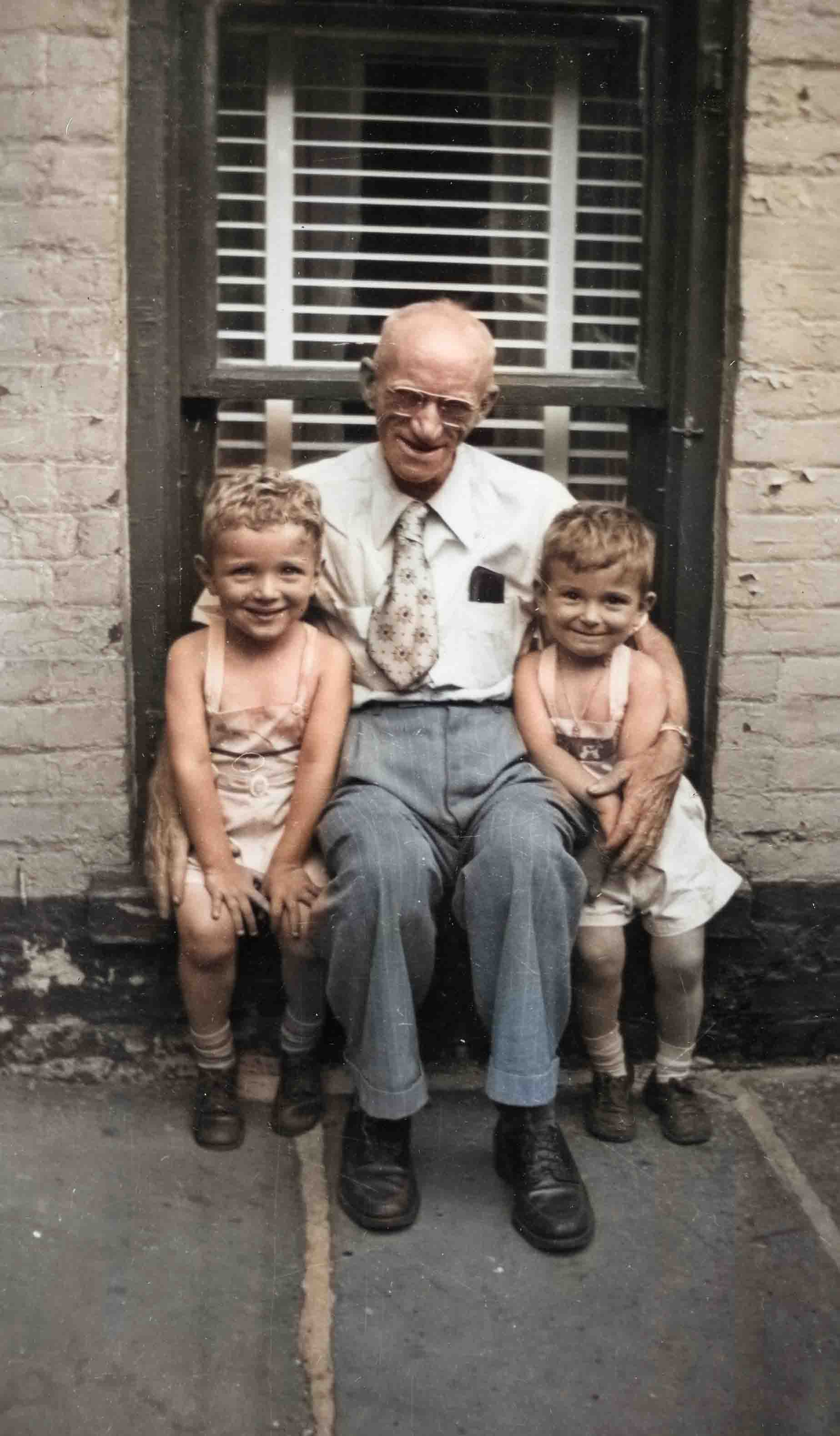
ENDPIECE: It is the practice of the Pastor to speak after the Closing Hymn, but before the Benediction. This, then, is an précis of what the pastor said before the blessing: (The pastor holds up an 8×10 picture of his grandfather and two children.) “This is a picture of my grandfather. The two youngsters are myself and my brother. Was there a special bond between us? I think so. Is there a special bond between us and God? I think so.”

BENEDICTION: God’s Word lights our path. The risen Christ dwells among us. The Holy Spirit, guides, protects and sustains us. Let us go forth from this service of worship and offer service to the world in the name of Christ, for the grace of God is deeper than our imagination, the strength of Christ is stronger than our need, the communion of the Holy Spirit is richer than our togetherness. May God guide and sustain us today and in all our tomorrows. Amen.

[1] This analysis is, in part, based on what is found on this passage and on this passage and on the whole 6th Chapter of John in The New Interpreter’s Bible: the Electronic Edition. Needless to say, the Electronic Edition of The New Interpreter’s Bible has the same information as the printed edition.
Posted in Uncategorized | Leave a comment

SERMON ~ 08/08/2021 ~ Membership ~ South Freeport Congregational Church, UCC, South Freeport, Maine

08/08/2021 ~ Proper 14 ~ Nineteenth Sunday in Ordinary Time ~ Eleventh Sunday after Pentecost ~ 2 Samuel 18:5-9, 15, 31-33; Psalm 130; 1 Kings 19:4-8; Psalm 34:1-8; Ephesians 4:25-5:2; John 6:35, 41-51.

YOUTUBE Video of the complete service of worship:
https://www.youtube.com/watch?v=9yjPZhdNbr4

Membership

“Get rid of all bitterness and wrath and rage and anger and wrangling and slander, malice of every kind. In place of these be kind to one another, tenderhearted, compassionate, mutually forgiving— forgiving one another— as God, in Christ, has forgiven you.” — Ephesians 4:31-32.

In my comments today I am going to mention several people who were well known in show business decades ago. They will be known to those of us who are of a certain age. Dare I label that age as ripe?

Younger folks do not have to take my word for it that these people were famous. You can GOOGLE it. However while I do need to mention these famous people of yesteryear for context, in a real sense what I will say has little to do with them. Indeed, the place I need to start is by telling you something about my late Father. (Slight pause.)

Dad was a graduate of Manhattan College, in New York City. When he was a Freshman one Owen Patrick Eugene McNulty was a Senior. Even those of the aforementioned ripe age will not know the name Owen Patrick Eugene McNulty. But you might know the stage name eventually adopted by this performer— Dennis Day. (Murmurs of agreement are heard.) I can hear some people agree that they remember Dennis Day.

Here’s the second name we of a ripe age will know: Jack Benny. Benny and his writers concocted a variety show— music and sketch comedy— first on radio then on television. Indeed, it might be argued the writers of the Benny Program invented the form which eventually evolved into what we today call a sitcom— situation comedy.

Let me come back to this Owen McNulty/Dennis Day fellow. He appeared in sketches first on Jack Benny’s radio program and later on Benny’s television show. But he was also a singer, an Irish tenor, who supplied some of the music for the show. Both my parents liked Dennis Day and liked the Benny program.

But this McNulty/Day fellow was very special for my father. You see, every time Day came on the TV screen, my father invariably said (and I am quoting), “Dennis Day— he’s a Manhattan College graduate, you know.” (Slight pause.)

Even though or perhaps because I was a child, I always wondered why my Father said that. The questions which came to my mind ran along these lines— a Manhattan graduate— did that make Dennis Day a special human being, above reproach, placed in a special category, a level of sainthood of which I was blissfully unaware? (Slight pause.)

When I got older I realized my father was saying Dennis Day— a Manhattan College alumni— is a member of my club. I am a member of Day’s club. Dad was saying that they— this well known Irish tenor on TV and Joe Connolly, Sr., someone who could not carry a tune in a bucket and was a less than well known High School English teacher— were members of the same club. (Slight pause.)

These words are from the work known as Ephesians: “Get rid of all bitterness and wrath and rage and anger and wrangling and slander, malice of every kind. In place of these be kind to one another, tenderhearted, compassionate, mutually forgiving— forgiving one another— as God, in Christ, has forgiven you.” (Slight pause.)

You may or may not know this. Different churches and different denominations have different ways of counting membership. Some churches say Baptism, infant or adult, constitutes membership. Others say if you receive Communion you are a member. Some churches say you need to be confirmed to be a member.

And when it comes to Confirmation, churches cannot even agree on what Confirmation is. In the Roman tradition Confirmation is a Sacrament. In Protestant Churches it is a rite of the church but not a Sacrament.

When it comes to joining a church some churches say Baptism— again, infant or adult— is the key. Others insist you have to take membership classes before you can join. Some say you only have to meet with the pastor or deacons. Many say you need to go through some kind of ritual, a ceremony in which a person formally joins a church.

Indeed, churches, themselves, have so many rules and categories for counting membership that often the churches don’t know who is a member and who is not. But most do put some kind of limit on membership, some necessary step which determines membership, say there is some way to join the church. (Slight pause.)

So, how should church membership be counted? (Slight pause.) I want to suggest asking how church membership is or should be counted is the wrong question. And I want to suggest the author of Ephesians got it right.

You see, my Dad was right in the sense that he and Dennis Day were in the same club, Manhattan College graduates. But church membership is not that kind of club. And church membership should not be like a club, despite any strictures we place on it.

Churches are not or at least should not be a place for special human beings or a place which allows someone to be above any kind of reproach or a place that slots you in some special category, some level of sainthood. Churches are for real people. Churches are for flawed people. Churches are for all people.

Churches are also places, as the writer of Ephesians suggests, where we can (quote): “Get rid of all bitterness and wrath and rage and anger and wrangling and slander, malice of every kind.” Churches are also places where we need to (quote): “…be kind to one another, tenderhearted, compassionate, mutually forgiving— forgiving one another— as God, in Christ, has forgiven you.” (Slight pause.)

For a moment, let’s move in another direction about church membership. The Rev. Dr. Martin Luther King, Jr. told us the worship hour on a Sunday is the most segregated hour in America.

And we know from the other writings of Dr. King what he said was not confined to race— class, education, income, profession— all kinds of things separate people into groups. So it’s a human reality to say churches, by their nature, are club-like.

Put differently, a reality of church is that like people worship with like people. And that statement at one and the same time is both theologically abhorrent and it is true. So how do we, how can we deal with that reality? (Slight pause.) Well, first we name it. As painful as it is to admit that reality, unless we name it we will not deal with it.

But let me take that one step further. If you read the brief biography which let people know I was to be your “Bridge Pastor” it said I was a pastor at one church in rural, Upstate New York for 23 years. Over the course of those 23 years a lot of people joined that church.

When folks talked to me about joining I always said this. Let’s assume you are waiting for a train in a train station. And the church is the train you want to board.

Here’s the problem. That train is going to come through the station and it is not going to stop. It been around 200 years and has quite a head of steam. If you want to join you need to stick out your hand and grab onto it and pull yourself on board.

Why? Every organization, a church, a business, a town, has it’s own way of doing things. And that way of doing things is already established. To be clear, that way of doing things will change and even may even change radically simply due to the fact that you joined, because you joined. But another reality is often the change will be slow.

This brings me back to that which is both theologically abhorrent and true. The church is unfortunately in some ways like a club. Why? Like people worship with like people. And what are we to do about that? What can we to do with that? (Slight pause.)

I want to suggest the writer of Ephesians has two answers for us. I have already referenced the first answer. “…be kind to one another, tenderhearted, compassionate, mutually forgiving— forgiving one another— as God, in Christ, has forgiven you.”

If you think that is hard to do… you are right. It is hard. But the second answer the writer of Ephesians gives is even harder. (Quote:) “…try to imitate God, as beloved children. Walk in love and live in love, as Christ loved us and gave of self….” Amen.

South Freeport Congregational Church, UCC, South Freeport, Maine
08/08/2021

ENDPIECE: It is the practice of the Pastor to speak after the Closing Hymn, but before the Choral Response and Benediction. This is a précis of what was said: “If you saw the service I led by video in June you know it is my practice to say something before the Benediction. Today’s entry is a quote from Catholic theologian Richard Rhor. “Christianity is a lifestyle— a way of being in the world that is simple, non-violent, shared and loving. However, we made it into an established religion (and all that goes with it) and avoided the lifestyle change itself. One could be warlike, greedy, racist, selfish and vain in most of Christian history and still believe that Jesus is one’s ‘personal Savior.’ The world has no time for such silliness anymore. The suffering on earth is too great.”

BENEDICTION: The loving kindness of God, the steadfast love of God, is always present to us. Therefore, may we love God so much, that we love nothing else too much. May we be so in awe of God, that we are in awe of no one else and nothing else. Amen.

Posted in Uncategorized | Leave a comment

SERMON ~ July 18, 2021 ~ “Teaching Sheep?”

VIDEO:
https://www.youtube.com/watch?v=wcgQbjD-iyc&list=PLZLVrA0zg6Cn0QgvjwtFH1HqcyZb9q_7v&index=1

July 18, 2021 ~ Proper 11 ~ 16th Sunday in Ordinary Time ~ Ninth Sunday after Pentecost ~ 2 Samuel 7:1-14a; Psalm 89:20-37; Jeremiah 23:1-6; Psalm 23; Ephesians 2:11-22; Mark 6:30-34, 53-56.

Teaching Sheep?

“And so when Jesus went ashore, there was a crowd waiting; and the Rabbi felt compassion for them, because they were like sheep without a shepherd. So then Jesus began to teach them many things.” — Mark 6:34.

I would bet what I am about to say is true for many of us. There are people in our lives with whom we have a connection and the only way I have of describing that connection, the only language I have, is to say the connection is in some way ethereal.

What does that mean? A description— sometimes this kind of connection means when that other person is in pain we feel it.

But there are other kinds of connections too. Here’s one: it’s when you fully understand what another person says, as they say it1fully understand. But even that kind connection, one grounded in communication, that connection feels in some way ethereal, you don’t quite understand what’s going on.

That’s the kind of connection I had with one of my professors at Bangor Theological Seminary, the late Dr. Ann Johnston. Ann was a fascinating individual. A Roman Catholic nun, she held a Ph.D. in Hebrew Scriptures, was fluent in ancient Hebrew and, despite being a Roman Catholic nun, was teaching at a Main Line Protestant Seminary.

Ann and I had similar backgrounds which perhaps made connections possible on a number of levels. There was the obvious one. She was Roman Catholic. I came to maturity in that tradition. But she also grew up in New York City, as did I.

She had a sibling who lived in the Saranac Lake area as do I, so we both know what that neck of the woods is about. In any case, for reasons beyond me— although I think at least some of the aforementioned background must have played into it— we understood one another, communicated on many levels.

Let me tell you story about that. Any student who goes to a college or a graduate program should visit the school in which they have an interest, meet a professor or two. It’s also wise for a prospective seminary student to visit that seminary and meet a professor or two. And so, I visited Bangor Seminary where I had a chat with Ann, the first time we met.

Not a fifteen minutes into our discussion— and this was the first time we ever met— she tilted her head a little to the side and said, “Joe, I think you need to be ordained.” My memory was immediately thrust back about fifteen years to when the Rev. Carol Anderson, who was among the first women to be officially ordained a priest in the Episcopal Church and she was my pastor at that point in my life, Carol said to me, “Well Joe, when are you going to become a priest?”

Back to my relationship with Ann— I suppose the bottom line is we could hear what one another said clearly. Here’s an interesting example of that.

In a class Ann would give verbal instructions as to what she might want to see in a given assignment, a paper. After assigning a paper, she once came back to the classroom with a totally looking chagrined one week later. She had a stack of papers in her hand.

She announced nearly everyone in the class was going to have to re-do the paper we had handed in a week before. She apologized and said since so many of us had not returned a paper she deemed adequate, it must have been her fault. She must have given poor instructions.

She then told us she had written extensive comments on the papers she was handing back in the hope this would help. At that point she went around the room handing back papers with comments scrawled across the sheets.

She had said, however, not all the papers needed to be redone. She said nearly everyone was going to have to re-do the paper.

When she gave me my paper at the top of the first page I found scrawled in red a grade of A+. She made some other comments throughout the text, as she always did. But the A+ stopped me cold.

I never had the nerve to ask Ann what I did right. I have always, however, attributed the success of that paper to the fact that when she said something I heard it fully. We connected on some level beyond any logical explanation. (Slight pause.)

We hear these words in Mark: “And so when Jesus went ashore, there was a crowd waiting; and the Rabbi felt compassion for them, because they were like sheep without a shepherd. So then Jesus began to teach them many things.” (Slight pause.)

For me the story I just told about Ann Johnston and myself raises three questions. First, does one study with a professor, a teacher, or does one study under a professor, a teacher? I think that answer is evident. You need to work together. Unless you work together, work with a teacher, deep learning, leaning how to think, will not be accomplished.

Learning is, you see, not about acquiring a set of facts. Facts are often readily available. Learning is discovering how to think, not what to think.

And it is a mistake for a student or a teacher to picture learning as if it’s like filling an empty gas tank. Any student, even the youngest, comes to any learning situation with knowledge and experience. So learning, education, is not about filling a tank. It’s more like designing a new one.

Second, what can you learn from a professor, a teacher? Surely there are limitations, no matter how solid the personal connection. And yes, there are limitations, especially if we’re talking about how to think. I’ve always said you learn what you can from a given teacher. The rest, what you cannot learn from that teacher, you leave behind.

However, from the perspective of the student that means you first need to understand how you think, what are your methods and patterns of thinking. That needs to happen before you can learn different, new methods, new patterns of thinking, new patterns a teacher might help you learn. It is, of course, hard to break out of our current methods and patterns. But I would also suggest when you do get to these new patterns of thinking is when learning truly begins to happen.

The last question I want to raise is, I hope, obvious. What kind of effort, what kind of involvement is necessary on the part of the student? (Slight pause.)

Well that brings us to the story we heard about Jesus and the disciples, and that crowd who followed Jesus and the disciples to a remote, deserted place. I think we too often read this story with Twenty-first Century eyes and we, therefore, miss something vital.

We presume Jesus, the teacher, is the sole driver of the story. What we miss is how involved the crowd is. The crowd drives the story with the eagerness of each individual in the crowd, their willingness, their journey to that remote, deserted place. For me that willingness to go to a remote, deserted place tells us something different, something new, a new way of thinking, a new way of life, is being sought— it’s being sought by these people.

So, let me repeat something I said earlier. Learning is not about acquiring a set of facts. Learning is about discovering— eagerly discovering— how to think, not about learning what to think. Learning is not about what to thing but how to think.

And that’s another Twenty-first Century mistake we make as we read this the story. We assume Jesus, the disciples, these teachers, are merely dispensers of facts.

No! After all, what is Christianity about? Is Christianity about a set of facts? Or is Christianity about a new way of life, a new way of thinking, a new way to think about the call of God on our lives, the call for our lives and the call of God on the life of the whole world and the call of God for the life of the whole world?

Put differently, is Christianity about the Realm of God, the Dominion of God being present to us here, now and about our participation in the Realm of God, the Dominion of God, right here and right now? Is Christianity about being empowered to live into that Realm, that Dominion, that new way of thinking, or is Christianity simply about lip service, an ability to spout facts, recite Bible verses? (Slight pause.)

It’s clear to me Christianity is about a way of life, a new way of thinking, a new way of seeing life. This way of life is called covenant love— love of neighbor, love of God. And from what I see and hear in Twenty-first Century society, love of neighbor, love of God would appear to me to be too often in short supply.

So if love of God, love of neighbor is, for Twenty-first Century society, a new way to think, a new way to see life, a new way to understand God is present with us, here, now, perhaps, perhaps there is a call on our lives. Perhaps our call is like the call of the disciples, a call to share the love of God. But maybe, just maybe our call is also like the crowd who went to that deserted place, eager to learn, eager to discover, eager to think in new ways. Amen.

07/18/2021
North Yarmouth Congregational Church, United Church of Christ

ENDPIECE: It is the practice of the Pastor to speak after the Closing Hymn, but before the Choral Response and Benediction. This is an précis of what was said: “The text from Mark says the people (quote:) ‘…were like sheep without a shepherd.’ But again our Twenty-first Century way of thinking does not understand what’s happening here. The text also says the people needed a shepherd. A shepherd is not someone who dominates and orders others around. A shepherd is someone who guides, who helps. Jesus is a shepherd, a guide, a teacher who helps us to seek new ways of thinking, new ways of seeing the Realm of God, the Dominion of God. If we also engage in teaching our job is to also be a shepherd, to guide, to help.”

BENEDICTION: This is the blessing used by natives of the islands in the South Pacific: O Jesus, please be the canoe that holds me up in the sea of life. Please be the rudder that keeps me on a straight path. Be the outrigger that supports me in times of stress. Let Your Spirit be the sail that carries me though each day. Keep me safe, so that I can paddle on steady in the voyage called life. God of all, bless us all so we may have calm seas, a warm sun and clear nights with star filled skies. Amen.

Posted in Uncategorized | Leave a comment

SERMON ~ July 11, 2021 ~ “The Plumb Line” ~ North Yarmouth Congregational Church, United Church of Christ.

VIDEO ON YOUTUBE:
https://www.youtube.com/watch?v=wsIrmNA-GGg&list=PLZLVrA0zg6Cn0QgvjwtFH1HqcyZb9q_7v&index=2

July 11, 2021 ~ Proper 10 ~ Fifteenth Sunday in Ordinary Time ~ Eighth Sunday after Pentecost ~ 2 Samuel 6:1-5, 12b-19; Psalm 24; Amos 7:7-15; Psalm 85:8-13; Ephesians 1:3-14; Mark 6:14-29.

The Plumb Line

“This is what the Sovereign, Yahweh, showed me: God was standing beside a wall built with a plumb line, with a plumb line in hand. / “what do you see, Amos,?” Yahweh, God asked. / And I said, “A plumb line.” — Amos 7:7-8a

If you were here last week or heard it online you know I told a story about being drafted into the army in 1968 and going to Vietnam. Today I want to start with a life story from even a little before that. If you accuse me of telling stories I will plead guilty.

In January of 1961, January 6th to be precise, to be exact, my family moved into what was for us a new house. I was 13.

I can name the date with accuracy for two reasons. January 6th is the Feast of the Epiphany, the feast which celebrates the arrival of the Magi, often called “Three Kings Day.” My mother called it “Little Christmas.”

I think she called it “Little Christmas” because of her very Catholic upbringing. But what really made this particular “Little Christmas” special for my mother is on that day she was now in a new house and she repeated over and over numerous times because of a new house it was not just “Little Christmas” for her. This was Christmas.

I can also identify that date in January because just days later, January 20th, 1961, John Fitzgerald Kennedy was inaugurated. And I know I watched the inauguration in that new house. My very Catholic parents, being very Eisenhower Republicans, still felt pride that Kennedy, the first Catholic President, had been elected.

January 20th, 1961 was on a Friday. I was in the seventh grade. So, why was I not in school but watching the inaugural?

There had been a major East Coast snow storm and all the schools were closed for the day. I am quite sure a certain 13 year old altar boy felt getting this day, a day on which the inauguration of JFK happened and being home from school because of a snowstorm, was a gift from God.

Back to this new house. The bathroom sink was simply attached to the wall, no legs, no cabinet, no storage space underneath. You could see the drain pipe.

That Summer my Mother asked me to build a rolling cabinet which could be pulled in and out and fit under the sink. I have no idea where she found plans to make a rolling cabinet— this was 1961— no Internet, no place to search for plans, but she found some.

These instructions were quite specific as to what was needed— lumber, wheels, paint. What the plans did not have was measurements since all sinks are different. They told you how to measure but measuring was left up to the builder— in this case me. In measuring I, effectively, set the standards by which the cabinet was built.

And, having measured, I got to work. Measuring was important since the cabinet did have to fit under the sink and roll in and out. Too tall, it would not fit under; too short or wide, there would be too much space around the edge.

I became very familiar with a tape measure and a carpenter’s level, a bubble level. The level was especially needed because the thing had to roll evenly.

If there is any lesson I learned in putting this together it’s the importance of measuring. Measuring sets up standards, especially when measuring is up to you. I am proud to say not only did I successfully complete the cabinet but it was in the bathroom until it got re-built some 20 years later. (Slight pause.)

These words are in the work known as Amos: “This is what the Sovereign, Yahweh, showed me: God was standing beside a wall built with a plumb line, with a plumb line in hand. / “what do you see, Amos,?” Yahweh, God asked. / And I said, “A plumb line.” (Slight pause.)

In the original texts the prophets of the Hebrew Scriptures are sometimes referred to as “seers.” Why? They were believed to be able to see things others could not.

Clearly Amos sees things others do not. In this case Amos sees God at a wall with a plumb line. A plumb line— a very ancient device used to keep things straight, level. It’s is a string with a weight, an instrument used to provide measurement, a reference line.

I therefore think one question for us becomes what is being measured? Is it the people of Israel? Is it us? I think neither.

I say neither even though the text makes it clear the Israelites failed when being measured. That failure, their failure, is not the point. They fail because a comparison is being made. So the real question is ‘a comparison to what?’ (Slight pause.)

I want to suggest the plumb line, a tool of measurement and a wall, the finished product, represent standards. What is the standard to which God invites us? Love. And in theory at least, justice— the justice of God— needs to flow from love.

I think we miss, do not understand, this very simple idea way too often: justice must flow from love. We miss this because we see justice as being one sided. We speak in terms of ‘my justice’ or ‘our justice.’ This sets up sides. But the place to which God invites us is love of all and therefore the place to which God invites us is justice for all.

Further, I would argue justice is not singular. My justice, alone, can never be a fullness of justice because justice for all cannot be possessed by one individual. Hence, I would also argue justice can happen only in community and through community.

That brings me back to my building a cabinet and standards. Measuring, as I did, as I had to do, in building the cabinet, is important. Standards need to be both attained and maintained. For me, the wall and the plumb line, these images Amos saw, have to do with identifying a standard. (Slight pause.)

And to reiterate, the standard of God is love. And both justice for all and all justice flow from love. Therefore, our problem can be twofold: first, sometimes we fail to correctly, accurately, identify that standard. Second, we sometimes fail to maintain that standard. (Slight pause.)

Earlier I said the cabinet I built lasted twenty years. Let me say two things about that. First, the plans told me how to do it but did not tell me what the measurements were.

God tells us how to it, how to do justice: love God, love neighbor. Then God places the measuring of justice— a measurment determined by love— in our hands. God relies on us. If the fact that God relies on us does not give us pause nothing will.

Second, wear and tear, time, use, does deteriorate cabinets. Wear and tear has the same effect on us on our standards, our understanding of justice.

So guess what? We have exactly the same problem as the Israelites— determining the standards and maintaining the standards.

But I think there is clearly one thing we can learn from the visions of Amos. I maintain that for Amos love and justice are one. But seeing love and justice as intertwined, seeing that as a standard is something with which we have a hard time.

A basic reason for that is rather than letting God’s love be our standard we let the culture take over. Here’s an example of that, perhaps an odd one but it’s one I like. I am sure we’ve all heard of Theory of Relatively. I am not suggesting we understand it, I’m not sure I do, just that we’ve heard of it.

Most of us hear the term Theory of Relativity and we twist the meaning. We say, O.K.— that means everything is relative, mobile, moves. No— the theory of relatively— E=MC2— says energy and matter change. These are mobile.

But the letter C represents the speed of light, 186,000 miles per second, the ultimate standard. The speed of light never changes. The Theory of Relativity says everything is measured from that standard, that plumb line. What is measured changes. The plumb line does not change.

The plumb line of God is love. Love God; love neighbor. That is what needs to define how we measure our life, ourselves, our life with one another, how we measure justice. You see, everything is relative only in the sense that everything needs to relate to loving God and neighbor.

Is that simple to do? No. If it was simple we would be much better at it. But that does not mean we should give up. We need to continue to engage in building the cabinet. We need to continue to use the plumb line called love. Amen.

07/11/2021
North Yarmouth Congregational Church, United Church of Christ

ENDPIECE: It is the practice of the Pastor to speak after the Closing Hymn, but before the Choral Response and Benediction. This is an précis of what was said: “I am sure most of us have seen a classic New Yorker type cartoon with a scraggy looking bearded man in a robe carrying a sign with a prediction of the apocalypse: ‘The end of the world is coming.’ I once stumbled across a good version of that cartoon. Someone with a scraggy looking beard was wearing in a robe and carrying a sign. The sign said, ‘The world is not coming to an end. Therefore, you must learn to cope.’ And that is part of the issue, is it not? Things are not perfect. But we are called to do what we can to help things be better and to do so through love.”

BENEDICTION: Let us, above all, surround ourselves with the perfect love of God, a love which binds everything together in harmony. And may we love God so much, that we love nothing else too much. May we be so in awe of God, that we are in awe of no one else and nothing else. Amen.

Posted in Uncategorized | Leave a comment

SERMON ~ 07/04/2021 ~ “Freedom and Responsibility”

The video of the complete service is found here:
https://www.youtube.com/watch?v=GuqcM7oWTeA

Note: the lighting is not good.
**********************************
07/04/2021 ~ Proper 9 ~ Fourteenth Sunday in Ordinary Time ~ Sixth Sunday after Pentecost ~ 2 Samuel 5:1-5, 9-10; Psalm 48; Ezekiel 2:1-5; Psalm 123; 2 Corinthians 12:2-10; Mark 6:1-13 ~ Fourth of July Holiday on the Secular Calendar ~ Communion.

Freedom and Responsibility

“Then Jesus summoned the Twelve and began to send them out in pairs,…” — Mark 6:7a.

I do not remember the exact date the letter arrived. I do know it was the first week of November, 1967. I was 19.

Those of a certain age will be familiar with the opening words in the letter and recognize exactly what they meant. (Slight pause.) “Greetings from the President of the United States.” (Slight pause.)

For those a little younger, I need to state this letter was from President Lyndon Baines Johnson and informed me I was being drafted into the Armed Forces of these United States. This was my draft notice.

The draft letter had one other piece of news. The date set for my induction was December the 5th, my mother’s 44th birthday— Happy Birthday, Mom. (Slight pause.)

At the time I was working at a large corporation as a computer operator. I gave them two weeks notice. Much to my surprise that afternoon my boss told me the company was acting on my behalf to get the draft notice postponed. That would buy them time for me to train someone to do my job.

They had not asked my permission to intervene. They just did it. I went along because I did not want to be inducted on my Mom’s birthday.

Within days I got a second draft notice for January 20th, 1968. That the corporation for which I worked could get my draft postponed without my input was a life lesson in real world power.

And so on January 20th, 1968 I was off to Fort Jackson, South Carolina, for Basic Training. Late March landed me in Fort Lee, Virginia, for Advanced Training.

The next significant date in this sequence is hard to forget. 53 years ago today— July 4th, 1968— I arrived in Vietnam— Happy Independence Day. (Slight pause.)

I’ve always said my little brother is the one who got the smart genes in my family. You see, I was drafted because the first time I went to college I dropped out. My brother did not.

By the time he was eligible to be drafted draft numbers were assigned by date of birth. The system used when I was drafted chose individual people at random. It’s the only time I ever won a lottery.

My brother then proved he was also clever. He applied for conscientious objector status and got it. I could have done that. I knew all the clergy who signed letters to support him. So, why did I not do that? (Slight pause.)

Rumor to the contrary, the system of government under which we live in American is not a democracy nor is it a republic. It is a democratic republic. [1] Any competent civics text book will say that. We just don’t pay much attention to the term democratic republic as political commerce seems to prefer the mindless rhetoric which confines us to the words democracy or republic, neither of which is totally accurate.

So, what does it mean to be part of a democratic republic? Perhaps this will help: in the initial draft of the Declaration of Independence the inhabitants of the 13 colonies are referred to as (quote) “subjects.” But then, amazingly, Jefferson wiped the word “subjects” out of the text and changed the word from “subjects” to “citizens.”

As “citizens”— no longer subjects— we became and are a people whose allegiance is to one another, not to some king. [2] I believe from that point forward as a nation we have been bound one another in mutual covenant— citizens not subjects.

So, as a citizen of this democratic republic, as someone designated by chance, by tradition, by law and by age to serve I thought I had a responsibility to others. You may agree or disagree with that. But that I needed to be responsible is where I came down.

Put another way it’s this simple: real freedom can be found only in the collective not in the individual, indeed, not in individuality. Therefore and paradoxically, real freedom depends on the responsibility assumed by each individual to the collective, to each other. (Pause.)

These words are from the work known as Mark: “Then Jesus summoned the Twelve and began to send them out in pairs,…” (Slight pause.)

Mark here addresses how the Good News spreads. When I say ‘how the Good News spreads,’ we need to heed not the details but the principles. In this case I think the first principle is mutual responsibility.

The disciples, you see, are sent out in pairs. So perhaps next we need to ask what is it which binds them in this mutual covenant? The message, the Word of God Jesus invites them to proclaim is (quote): “repentance.”

The Biblical meaning of repentance is neither regret nor feeling sorry. Biblical repentance is turning toward God with your whole being, turning one’s life over to God.

So next we need to ask ‘how do the disciples go about turning toward God, turning their lives over to God?’ In this case Jesus invites them to take nothing for their journey except a staff— no bread, no bag, no spare tunic, no money. Here is a different way to put that: focus your life on God and the place to which God calls you— nothing else. In modern language, they simplifed their lives.

But that simplify stuff also comes back to the fact that they go out two by two. To really simplify they needed to rely on one another. Because of that commission of mutual reliance, this seems clear to me: no one individual has the key or is in charge. No one individual has any formula. No individual can fix everything. Put another way, no one is God except God.

And so they go out two by two, embrace the humility found in accepting communal responsibility. They accept one another for who each of them is. They embrace the humility of needing each other. And this embracing of the other can and does form living community. (Slight pause.)

I need to step back for a moment and say one very important thing about the Gospel we know as Mark. While it is not said in this passage in Mark, especially in the parables, Jesus talks about the realm, the reign of God which has drawn near.

That the reign of God has drawn near is an overall theme of the Gospel. I want to suggest this reign of God has something to do with the freedom granted by God.

I also want to suggest this freedom also has something to do with the humility and the repentance found in accepting communal responsibility, responsibility to one another. And that brings us back to this two by two concept. Jesus is focused on the centrality of community in proclaiming the realm of God. (Very long pause.)

Many feel the opening words of the Declaration of Independence about equality, life, liberty, the pursuit are the most important words in the document. And these days we tend to take those words personally, as if they were about an individual, about us.

However, I believe for the ones who signed the document, who lived through those tumultuous times, some words towards the end of the Declaration are equally important. (Quote): “…for the support of this Declaration, with a firm reliance on the protection of divine Providence, we mutually pledge to each other our Lives, our Fortunes and our sacred Honor.” (Slight pause.) “…we mutually pledge…” The signers of the Declaration accepted, indeed, embraced communal responsibility. (Slight pause.)

No individual is up to the task of forming community. Being a lone ranger works only in the movies. We need to rely on one another, be in covenant with one another to see the full reality of freedom and its gifts.

As Christians who wish to seek the freedom promised by the reign of God we must work toward and in community. And for Christians community does not mean just those you know. For Christians community means everyone, all people who on earth do dwell.

So, perhaps the way we need to think about freedom on this Independence Day is that it is really “Interdependence Day,” a day on which we rely on one another with mutual respect and mutual responsibility. Living in community is sacred. Amen.

07/04/2021
North Yarmouth Congregational Church, U.C.C. [3]

ENDPIECE: It is the practice of the Pastor to speak after the Closing Hymn, but before the Benediction. This, then, is an précis of what the pastor said before the blessing:
“Before he won the Nobel Peace Prize I once had the privilege and honor of meeting Archbishop Desmond Tutu. This quote is from Desmond’s vast wealth of theological sensibility. ‘The wave of hate must stop. Politicians who profit from exploiting this hate, from fanning it, must not be tempted by this easy way to profit from fear and misunderstanding. And my fellow clerics, of all faiths, must stand up for the principles of universal dignity and fellowship. Exclusion is never the way forward on our shared paths to freedom and justice.’”

BENEDICTION: Let us place our trust in God. Let us go from this place to share this Good News: by God we are blessed; in Jesus, the Christ, the beloved of God, we are made whole. Let us depart in confidence and joy that the Spirit of God is with us and let us carry Christ in our hearts for God is faithful. Amen.

[1] https://en.m.wikipedia.org/wiki/Democratic_republic

[2] The Washington Post; Jefferson Changed ‘Subjects’ to ‘Citizens’ in Declaration of Independence; By Marc Kaufman; 07/03/2010 http://www.washingtonpost.com/wp-dyn/content/article/2010/07/02/AR2010070205525.html?nav=rss_email/components

[3] The video of the service is found here:
https://www.youtube.com/watch?v=GuqcM7oWTeA

Posted in Uncategorized | Leave a comment

SERMON ~ 06/27/2021 ~ Just Believe ~ South Freeport, Maine ~ Video

06/27/2021 ~ Proper 8 ~ Thirteenth Sunday in Ordinary Time ~ Fifth Sunday after Pentecost ~ 2 Samuel 1:1, 17-27; Psalm 130; Wisdom of Solomon 1:13-15, 2:23-24 or Lamentations 3:22-33; Psalm 30; 2 Corinthians 8:7-15; Mark 5:21-43.

Just Believe

“While Jesus was still speaking to the woman, some people came from the house of the synagogue officer and said to that officer, ‘Your daughter is dead. Why trouble the Teacher any further?’ But Jesus overheard the remark and said to the leader of the synagogue: ‘Do not fear— just believe.’” — Mark 5:35-36.

Given the Children’s Moment, you may have figured this out already. I am a Baseball fan. [1] I have been known to pull over to the side of the road to watch a Little League game. I lived in New York State and at different times I was in both New York City and in rural Upstate New York.

When I did live in New York, and it mattered not where, Upstate or Downstate, this is what people asked me about baseball: Yankees or Mets? Of course, when I lived in Maine— both before and currently— people who knew I was a baseball fan did not even bother to ask. They assumed I was a Red Sox fan.

I follow the Sox and I never stopped following them even when I was in exile in New York, but my real answer about team fandom is none of the above— not the Yankees, not the Mets not the Sox. I am not a team fan. I am a baseball fan. I follow baseball. Why?

If truth be told the only team for which I ever rooted was the Brooklyn Dodgers. Please note: that is not the Los Angeles Dodgers. That is the Brooklyn Dodgers.

And this proves I am old. I actually saw games in person at Ebbets Field, home of the Brooklyn Dodgers. My team went out of existence in 1957. That may be why I am a baseball fan and not a team fan. My… team… died.

However, since I did spend time in New York I know a lot about those teams. This is one story about the Mets. (Slight pause.)

These days the late baseball player Tug McGraw is probably best known as the father of country music singer Tim McGraw. But I remember Tug as an outstanding relief pitcher who played from the late 60s through the early 80s— 19 seasons.

McGraw was a part of the World Series winning 1969 Mets, the 1973 National League Pennant winning Mets and the 1980 World Series winning Philadelphia Phillies. Tug always had a way with words and what stands out in my memory about that is a catchphrase he invented for those 1973 Pennant winning New York Mets.

But before I talk about the phrase McGraw invented and for those of you who don’t follow baseball, I need to explain the 1973 Mets. Under their manager Yogi Berra (also someone who had a way with words— the classic phrase, “It’s too crowded; no one goes there anymore” belongs to him) under Yogi the 1973 Mets won the National League East title. But they did so with a terrible 82–79 record. They were certainly one of the worst teams to ever win a Division.

They then won the National League Pennant by beating a much stronger Cincinnati Reds team in the playoffs. And that’s where McGraw and his words come in.

On this terrible team every time the Mets won despite the rarity of a win, McGraw would shout, “You Gotta Believe!” And on this terrible team every time the Mets lost and there were a plethora of loses, McGraw would shout, “You Gotta Believe!”

And then the press picked up on it, quoted it. Then the fans picked up on it. People started making and holding up banners with the words “You Gotta Believe!”

If the Mets were winning by ten runs fans would shout, “You Gotta Believe!” If the Mets were losing by ten runs fans would shout, “You Gotta Believe!” (Slight pause.)

“You Gotta Believe?” Believe what? Believe you can throw a baseball, hit a baseball, win a game? What does it mean to believe? (Slight pause.)

These words are from the work known as Mark: “While Jesus was still speaking to the woman, some people came from the house of the synagogue officer and said to that officer, ‘Your daughter is dead. Why trouble the Teacher any further?’ But Jesus overheard the remark and said to the leader of the synagogue: ‘Do not fear— just believe.’” (Slight pause.)

What is belief? What does the word belief mean? Jesus says (quote): “Do not fear— just believe.” What is this invitation Jesus presents? (Slight pause.)

In her book Christianity After Religion: the End of the Church and a New Spiritual Awakening Diana Butler Bass says as the Protestant Reformation progressed people started to place a larger emphasis on Creeds. Why? Perhaps because a Creed can readily be seen as a list of beliefs, a set of principles onto which one is expected to sign, a list of beliefs one is expected to affirm.

But Creeds have actually been defined that way, as a list of beliefs, only since a little after the Reformation blossomed. What I find fascinating about the timing is not that it coincides with the Reformation but that it coincides with the dawn of what might be called Western science.

The list of noted scientists who lived into, in or were born in the 16th Century spans giants of the era from Da Vinci to Descartes. In this era people now look at the heavens through telescopes, see things they have never seen before, look at droplets of water through microscopes, see things they have never seen before.

In short, things we humans never saw before and things we humans never thought about before, things we never knew existed are coming into focus for us. We are making new discoveries. And we humans start to look at the world with a new set of lenses. We start seeing the world as a list of facts. (Slight pause.)

Now I, for one, do not want to ignore the benefits of the era. It leads to the later discoveries of the Enlightenment and everything this thrust into modernity brought.

I like facts. I happen to like electric lights, computers and indoor plumbing— all benefits of facts, information, data, science.

But I do want to suggest when we look at faith like a science problem, we are headed down a questionable path. So, why is that questionable? (Slight pause.)

The word ‘Creed’ comes from the Latin word Credo. We translate the Latin word Credo as ‘I believe’— fair enough. Indeed, the first words of the Nicene Creed in Latin are Credo in unum Deum… which we translate as “I believe in One God.”

But to say the word Credo means I believe, as if belief is a mere piece of data, is somewhat deceiving. You see, the intent of the word Credo is not an affirmation of a belief as a fact.

The deeper meaning of the word Credo is I give my heart. So, in order to translate the phrase Credo in unum Deum accurately we should say, “I give my heart to God.” (Slight pause.)

I want to suggest giving one’s heart to God is not about God as if God is just another item, a fact on a check list. If we give our hearts to God, if we say we believe in God, it means we long to be in a deep relationship with God.

All of which is to say in Scripture— and who knows, perhaps even in Baseball— giving one’s heart is a key ingredient of what it means to believe. So when Jesus says to the synagogue officer, “Do not fear— just believe”— that is what Jesus is talking about, giving one’s heart to God.

In short this is an invitation on the part of Jesus. Jesus invites the officer of the Synagogue and is perhaps even inviting us to give our hearts to God. (Slight pause.)

I think this is clear. We need to be in a relationship with God. That’s what belief is really about. I also think what we humans find out over time is, once we are in relationship with God, this becomes clear: God calls us, invites us, to be in relationship with one another. (Slight pause.)

Well, I have good news and bad news. Belief— this being in a relationship with God— is just like any relationship. Being in a relationship with God may be the easiest thing we will ever do. And being in a relationship with God might also the hardest thing we will ever do. Amen.

South Freeport U.C.C., Maine — VIDEO
06/27/2021

ENDPIECE: It is the practice of the Pastor to speak after the Closing Hymn, but before the Choral Response and Benediction. This is an précis of what was said: “It is my habit to say something at the conclusion of a service before the Benediction so I shall. I once had the privilege and honor of meeting Archbishop Desmond Tutu and that was before he won the Nobel Peace Prize. This quote is from Desmond Tutu’s vast wealth of theological sensibility. ‘In the end it matters not how good we are but how good God is. It matters not how much we love God but how much God loves us. And God loves us whoever we are, whatever we’ve done or failed to do, whatever we believe or can’t believe.’”

BENEDICTION: The work and the will of God is placed before us. Further, we are called to be faithful and seek to do God’s will and work. In so doing, may we love God so much, that we love nothing else too much. May we be so in awe of God, that we are in awe of no one else and nothing else. Amen.

[1] In the Children’s Moment Pastor Joe tried on some hats and some baseball hats. Then this question was asked: for which team does God root? God is not a fan of one team. God loves everyone.

Posted in Uncategorized | Leave a comment

SERMON ~ 03/07/2021 ~ Third Sunday in Lent ~ The Elijah Kellogg Church ~ “God the Teacher” – VIDEO:

03/07/2021 ~ Third Sunday in Lent ~ Exodus 20:1-17; Psalm 19; 1 Corinthians 1:18-25; John 2:13-22 ~ The Elijah Kellogg Church

God the Teacher

“Then God spoke these words and said, / ‘I am Yahweh, God, who brought you out of the land of Egypt, out of the house of bondage; / do not worship any gods except me.’” — Exodus 20:1-3. ~ VIDEO: https://vimeo.com/522911582>

I have no doubt about this. My late father was very smart, brilliant really. He graduated from High School and College first in his class. He graduated from college in 1943, when most others his age were fighting WW II.

Why was he not in uniform? He was born with a birth defect. His left arm could not be raised even to the height of the shoulder. If you can’t lift your arm you can’t lift a rifle to the right level to fire it. Hence, he was classified as 4F. So he stayed in school.

In that scholastic career he was very proud to have been the editor of both his High School and College year books. He loved writing and editing. But his first job out of college was not in writing or editing.

He took a job as an English Teacher at Regis High School in New York City, a school run by the Jesuits. Fun fact— Dr. Anthony Fauci is a Regis graduate so it is 100% likely my Dad was one of his teachers. Indeed, Dad’s entire working career was spent at Regis. And his colleagues thought of him as a master teacher. (Slight pause.)

Now, as I think many of you know, my ordained standing is with the United Church of Christ. First Parish in Brunswick sponsored me at Seminary. The United Church of Christ ordains people with a specific title— not Pastor but Pastor and Teacher.

And people sometimes tell me I’m a good teacher. A colleague once said of me that I did not know how to write a sermon without some teaching in it.

I say I simply inherited the teaching gene; I got it from my Father. But also and as some of you know, I had a career before ministry as a professional writer for theater. I had material performed Off-Broadway and Off-off-Broadway.

Becoming a pastor did not stop my writing. Pastors write sermons, newsletter articles, recommendations, etc. Which is to say maybe I also inherited a writing gene.

And Dad really wanted to be a writer, not a teacher. But the truth is not many people earn a living exclusively as a professional writer.

Indeed, many writers do not work at it full time. Even most TV writers don’t just write but produce the programs. Many writers also work teaching at colleges.

Which is to say people who only write for a living are freelance workers. Stephen King, despite his success, works freelance! Writers are, effectively, in business for themselves, by themselves. It’s a hard, dangerous, risk-taking way to make a living.

So here’s a final truth about my Father. Not long after college he got married and soon after there were children who had to be fed. In short, his situation did not line up well with the risk-taking the life style required of a professional writer.

Now I think my parents were happy and proud when I embarked on a writing career and had some success. They supported me in any way they could. I was, you see, fulfilling my Father’s dreams about being a writer. (Slight pause.)

I want to pass on something my Dad, the master teacher, said. He said he never gave any student a grade; they gave it to themselves. (Slight pause.)

If a student decides to participate or to not participate in the work— either way— the results will be obvious. Dad said all he ever did was record the results. (Slight pause.) He never gave any student a grade; they gave it to themselves. (Slight pause.)

We hear this in the work known as Exodus: “Then God spoke these words and said, / ‘I am Yahweh, God, who brought you out of the land of Egypt, out of the house of bondage; / do not worship any gods except me.’” (Slight pause.)

The words from this passage are commonly known as the Ten Commandments. However, among Jewish scholars, in Jewish tradition, this passage is not known as the Ten Commandments. This passage is known as the Ten Words.

That being said, rumor has it a good teacher understands repetition can be quite annoying but sometimes necessary. Repetitio Est Mater Studiorum— repetition is the mother of learning— was one of my Father’s favorite Latin aphorisms.

So please, do me a favor. Wherever you are— in your car, at home, please repeat this with me. The Ten Commandments are not commandments but are ten words. Say it with me now— The Ten Commandments are not commandments but are ten words.

Here’s another interesting point. In Biblical Hebrew the command tense does not exist, at least not in the same sense as in English— an order. In Hebrew the command tense does not exist. (Slight pause.)

Rumor has it a good teacher provides some basic information. Then it’s up to the student to decide what the information means, what to do with it, how to understand it, absorb it. I’ve just provided some basic information which questions if there are actually commands in the Commandments.

However and as you probably know, there is a cultural tendency, an imperative, to think of this passage as something strict and immovable. Given this basic information, let me suggest that image of the Ten Commandments as being imperatives etched in stone needs to be seen as a secular, even irreligious, concept. (Slight pause.)

Now let me offer some more information. There are range of faith traditions. These traditions cannot even agree on how to number the commandments.

The Jewish tradition, the Reformed tradition, the Eastern tradition and the Catholic tradition— four different groups— each number the ten in four different ways. One wonders why our society erects monuments with ten numbers. After all— whose version of the numbers should take precedence? (Slight pause.)

Further, Scripture, itself, has three different versions of “Ten Commandments.” Two of them, composed by different authors in different eras, are in Exodus, Exodus 20:1-17 which we just heard and Exodus 34:6-26. Another is Deuteronomy 5:6-21. As I said, why do we put up monuments which make these words seem so specific? Which version found in Scripture should take precedence? (Slight pause.)

Rumor has it a good teacher gives homework. There are numerous translations of today’s passage and the other passages which contain the so-called commandments.

Just for fun and when you have time, please look up multiple translations of each of these— maybe half a dozen or so translations. Compare them. Ponder the differences you see. What does it mean that translations render the words in different ways?

As I said, why do we put up monuments, pretending these words are static? Which translation, which words should take precedence? (Slight pause.)

This leads to an obvious question. I have just suggested the “Ten Commandments” are not what our culture makes them out to be, not strictures etched in stone. So what are the words of this passage about? (Slight pause.)

I think these words primarily make a claim about who God is. God is the One Who loved the Israelites, guided their rescue from bondage, led them toward freedom.

These words start with the love of God which means they start with an action of God, not a command. My claim is even the words which follow are not commands. Rather, they record a result, a result of participation in the work of God. These words are or should be a result of a relationship with God, a result of the love of God for humanity and a result of humanity participating in the love God offers.

Hence— especially when it comes to phrases like “No murdering! No giving false testimony…!” — these words are about the result of relationships, loving one another. These words speak of God’s love and invite us to participate with each other in the love God offers. These words should be looked at as the result of that love. (Slight pause.)

I want to suggest if we respect and love one another then we will be enabled to live out from rather than live within the “Ten Commandments,” live out from them in ways which will amaze us, empower us to see the world as God sees the world.

Indeed, I think the world sees the “Ten Commandments” as restrictions on behavior. I think God sees these words as a result of our participation in the work of God called love.

And I also think God sees the first words in the passage as a homework assignment, if you would. Our assignment is to participate in the Realm of God, the Dominion of God. And, if we participate in the Realm of God, the Dominion of God, then respect and love are sure to be a result. God is the great teacher. Amen.

03/04/2018
United Church of Christ, First Congregational, Norwich, New York

ENDPIECE: It is the practice of the Pastor to speak after the Closing Hymn, but before the Choral Response and Benediction. This is an précis of what was said: “People need to remember something very simple about the Ten Commandments. When Jesus, the Christ, was asked what are the greatest commandments the answer referenced Deuteronomy 6:4-5 and Leviticus 19:18, not the so called ‘The Commandments.’ So the question for us is simple. When will we follow the example of Jesus? When will we stop worshiping what the culture tells us is a god, indeed stop worshiping cultural idols? That carved image reference we heard in today’s reading tells us what we would be doing if we truly lived out from the commandments. We need to be worshiping something other than idols. Indeed, we need to worship the One Triune God, the God of relationship, the God of love.”

BENEDICTION: This is the message of Scripture: God loves us. Let us endeavor to let God’s love shine forth in our lives. For with God’s love and goodness, there is power to revive, power to renew, power to resurrect. So, may the love of God, the Creator, the Peace of Christ, the presence of the Christ, something which surpasses all understanding, and companionship of the Holy Spirit Who is ever present, keep our hearts and minds in the knowledge and care of God this day and forever more. Amen.

Posted in Uncategorized | Leave a comment

SERMON – 02/28/2021 – Blessed to Be a Blessing – ELIJAH KELLOGG CHURCH – HAPRSWELL, MAINE

02/28/2021 ~ Second Sunday in Lent ~ Genesis 17:1-7, 15-16; Psalm 22:23-31; Romans 4:13-25; Mark 8:31-38 or Mark 9:2-9 ~ Elijah Kellogg Church, Harpswell, Maine

Blessed to Be a Blessing

“…I will establish my covenant between me and you and your descendants after you throughout their generations for an everlasting covenant, to be God to you and to your descendants after you.” — Genesis 17:7.

This is, I hope, obvious. I am standing in the pulpit of a church named for the Nineteenth Century Congregational minister, Elijah Kellogg. Many of you probably know what I am about to say concerning this pastor but some may not.

Kellogg was born in Portland, Maine, graduated from Bowdoin College, Andover Theological Seminary and served the church in Harpswell from 1844 to 1854. He served other churches and in other ways. Today he may be best known outside of Harpswell for writing multiple series of books largely aimed at youth. Kellogg’s life spanned 87 years between 1813 and 1901. [1] (Slight pause.)

As it happens I’ve just finished reading a biography of John Quincy Adams, [2] himself a life-long Congregationalist. Adams was the son of a founder of this nation and in this sequence served as an Ambassador, a member of the Massachusetts legislature, a United States Senator, Secretary of State, President and after that, as a member of the House of Representatives. Adams’ life spanned 80 years between 1767 and 1848. [3]

While the lifetimes of these two do not exactly match there is overlap. Obviously when Adams died in 1848, Kellogg would have been the pastor at the Harpswell Church. Obviously, these two were very accomplished, very learned. (Slight pause.)

For a moment, let’s look at the times their lives spanned. In the lifetime of Adams this nation saw the declaration of and the struggle for independence, the formation of its government structure through the Constitution, the Louisiana Purchase which greatly expanded its territory and the war of 1812. Adams, himself, negotiated the treaty with Spain which expanded American territory to the West Coast. Adams was still alive when the so-called Mexican–American War ended.

It should also be noted during the lifetime of Adams, transportation changed from horse and wagon to railroads and from sailing ships to steam ships. Adams saw communication change from printed material taking weeks and weeks to travel anywhere to the telegraph which communicated over large distances in seconds. (Slight pause.)

Kellogg was born before the War of 1812 ended and lived through a chunk of history I’ve already connected with the life of Adams. Then after 1848 Kellogg saw the Civil War, the assassination of Lincoln, Reconstruction, economic depressions and the so-called Spanish–American War.

During Kellogg’s lifetime railroads were invented and then spanned the continent. The automobile, though not yet in mass production, was invented. Electrification was happening. The limitations of the telegraph were overcome by the telephone. (Slight pause.)

For those who think we live in tumultuous, unsettled, dangerous times today, just look at this cursory list of what happened in those lifetimes. And I have left out major chunks of what happened during their lifetimes, major chunks of what happened around them and to them. So, you might well ask, what’s the point? (Pause.)

We find these words in the Seventeenth Chapter of Genesis. “…I will establish my covenant between me and you and your descendants after you throughout their generations for an everlasting covenant, to be God to you and to your descendants after you.” (Slight pause.)

I think one thing we moderns do not grasp well is, in different eras, the same words can carry different meanings. I think the word covenant is a good example.

Today many take it to mean a contract, effectively you do this and in return I’ll do that. This meaning might have even been true of secular covenants in Biblical times.

But it clearly was not true with the covenant about which God speaks. God makes it clear this is not a give and take contract. (Quote:) “…I will establish my covenant…” This is one way. This is not you do this, I’ll do that. No demand is made by God. God simply establishes it. (Slight pause.)

Now, both Kellogg and Adams had what we today would call a classical education. In that era it was a given that one would study Latin and Greek at the levels we equate with Grade and High School. Then one would read Greek and Roman authors in the original languages in college. (Slight pause.)

That observation brings me back to the meaning of words. In the late Eighteenth and into the Nineteenth Century, for those who had a classical education, the kind Kellogg and Adams had, the word “virtue” did not mean what it mostly means today. For them the meaning much more rested on what it meant to the Greeks and Romans.

These days we often take virtue to be synonymous with morality, behavior within specific, often culturally decided boundaries. Back in the Kellogg/Adams era they would have leaned on what virtue meant to the ancients. In those times virtue meant putting the common good above one’s own interests. Hence, virtue was thought of as a lynchpin of public life. It was thought of as doing what supported the community. [4]

So, what did the practice of virtue entail? This… this is where the words virtue and covenant collide.

The lives of both Kellogg and Adams embodied the type of virtue I’ve defined— service. Indeed, no matter what was happening around them or to them they were dedicated to the common good, dedicated to striving to make the world a better place, addressing wrongs, even in tumultuous, unsettled, dangerous times. (Slight pause.)

It is at this juncture many people struggle with the covenant of God. Earlier I said it’s clear the covenant God proclaims is not give and take, not a contract. The common way to put this is simple. God is the prime mover. Therefore, God places no demand on us.

However, while making no demands God does invite us… invite us… to participate in covenant. Further, we are changed not by our participation. We are changed simply by the invitation of God. This change is clearly delineated as in the reading the name Abram is changed to Abraham. And, in a section of this passage not read today, the name of Sarai is changed to Sarah. We are changed simply by being invited to covenant.

And what is the message of this covenant to us? The simplest way to express the covenant God offers is the way Jesus put it: love God with all your heart, soul, mind and strength. Love your neighbor.

This circles us back to the idea of virtue. If we love God and neighbor we will strive to look for and be involved in the greater good, strive to seek out places where injustice abounds and work toward justice. Covenant means we will strive to do the work of God encompassed by justice for all and love of everyone. Hence, covenant means we will learn. Covenant means we will grow. (Slight pause.)

I do not want to mislead you. Living into, out from and through the covenant to which God calls us, a covenant of justice and love, a covenant of growth and learning, is not easy work. Ask Adams. Ask Kellogg. Their paths were not easy. But I think covenant work is the place to which God invites us, the place to which God calls us.

And so, let me reiterate: to where are we called? To what are we invited? We are called, we are invited to covenant. We are, thereby, called, invited to be a blessing to the world in which we live. And in so doing we shall be blessed. Amen.

02/28/2021
Elijah Kellogg Church, Harpswell, Maine

ENDPIECE: It is the practice of the Pastor to speak after the Closing Hymn, but before the Choral Response and Benediction. This is an précis of what was said: “You may have noticed I preached on Genesis but the choir sang an arrangement of Fairest Lord Jesus. What’s the connection? In the words of New Testament Scholar Nicholas Thomas Wright, what is seen in the resurrected Christ is the reality of covenant, the place we can come to understand God loves everyone. And hence, we need to move toward that virtuous task— we need to love everyone.”

BENEDICTION
We are commissioned by God to carry God’s peace, the presence of God, into the world. Our words and our deeds will be used by God, for we become messengers of God’s Word in our action. Let us recognize that God Who transforms us is forever among us. And may we love God so much, that we love nothing else too much. May we be so in awe of God that we are in awe of no one and nothing else. Amen.

[1] https://en.wikipedia.org/wiki/Elijah_Kellogg
Note: May 20, 1813 – March 17, 1901 which means he was 87 at this death.

[2] The Lost Founding Father: John Quincy Adams and the Transformation of American Politics by William J. Cooper.

[3] https://en.wikipedia.org/wiki/John_Quincy_Adams
Note: July 11, 1767 to February 23, 1848 which means he was 80 when he died.

[4] First Principles: What America’s Founders Learned from the Greeks and Romans and How That Shaped Our Country by Thomas E. Ricks.

Posted in Uncategorized | Leave a comment

A Christmas Eve Sermon – The Child

A Christmas Eve Sermon

As the date and place on the sermon below indicates these words were first offered on Christmas Eve of 2009 at the United Church of Christ, First Congregational in Norwich, NY. While I did not realize it at the time this sermon became the initial step in the development of an Advent/Christmas Cantata— The Child— written with the composer Tom Rasely. I decided to re-post the sermon this year.

The text of the Cantata (along with suggested readings) follows the text of the sermon.

There was a video done at the service of worship which first contained this Cantata. The URL is just the Cantata and not the full service. This is the URL where the video of the Cantata can be found:


12/24/2009 ~ The Eve of the Nativity of the Messiah, the Christ, the Feast of the Incarnation ~ Proper 1 ~ Isaiah 9:2-7; Psalm 96; Titus 2:11-14 ; Luke 2:1-14, (15-20).

The Child

“And she gave birth to her firstborn, whom she wrapped in bands of cloth and laid in a manger, a feeding trough for cattle, because there was no place for them in the inn.” — Luke 2:7.

The child lay against her breast. Blessed sleep had finally arrived. The child was quiet. She could feel the steady tempo of slumber in the warmth of the breathing against her skin.

It had been a long night and the dawn was not far off. Colic in an infant is never fun. This night the malady had been complicated by the surroundings.

This was not the best place for her and the infant and she knew it. But for now there was some shelter, when before there had been none.

In the last several nights, while circumstances she detested dictated they stay in these inadequate surroundings, it got very cold. But the hay which was all around made for good insulation.

Her husband had taken it, piled it up high, spread it out enough to accommodate them both and together, with the newborn child huddled in her arms, they burrowed into it. Just that extra bit of protection provided the necessary warmth to make it through the night. (Slight pause.)

Her husband was a good man. He was not wealthy. He was not handsome. He was not well spoken. In fact, he spoke very little. But she knew his soul.

When she looked into his eyes, she could see a man who knew God. She could see a man who cared about relationship and understood that relationship with God came before all. She could see a man who understood that all relationships into which one could enter were based on one’s relationship with God.

She knew he cared about her. She knew he cared about the child. (Slight pause.)

He never questioned about the child. She wondered about that. But she knew he was a good man, so there must have been a reason for the silence. And even though he was so often silent, he seemed to be able to communicate with her on a plane which precluded verbiage.

He had always been good to her. She hoped the child would learn from the example of this goodness. After all, example was the chief way any person learned about life, was it not? (Slight pause.)

She hoped for much for this child. Despite their poverty, or perhaps because of it, none of what she hoped for had to do with worldly possessions. Primarily, she hoped the child would be a kind person. She hoped the child would understand, if only for reasons of self protection, that the world was not always a place in which it was safe to live.

She had known people to be cruel and it seemed to her often they were cruel just for the perverse enjoyment of it. She hoped that the child would see, in this life, in this time, something of God’s light, something of God’s love, something of God’s dominion, in this world which seemed, so often, to be devoid of these. (Slight pause.)

Sometimes— in her dank, desperate moments— she thought the light of God’s love was too great a thing to ask for or to pray about. And perhaps she got discouraged because she had seen more than she wanted to see of the occupying army. They seemed… to not care— not care about people, not care about the sacred, not care about… life.

It appeared to her that they treated everyone as an annoyance, something to be used and then tossed aside. She had also seen more than she wanted to see of local government lackeys making sure they were first in line for any largess which might be available from the Romans. It was unnerving to know people could be so mercenary.

Whenever her attitude got too caught up in this way of thinking, a ray of hope somehow seemed to appear— a friend giving advice, a shopkeeper who was helpful— and then she realized not everyone insisted on looking out only for themselves. There were people who seemed to make a positive difference in this world. (Slight pause.)

The child stirred, made a noise, stretched out a hand… and rested again. This child, of course, made the positive difference for her. She could see in the child all the brightness of God’s creation, full blown in the little hands and feet, in the dark rings of hair on the tiny head, in the bright eyes which searched deeply into hers… for what? For hope? For support? For love? For relationship?

For some inexplicable reason, she could see in this child all the warmth and promise of the relationship to which God had committed in the covenants written in the Torah. For some inexplicable reason, she could see in this child all the warmth and promise of the relationship she knew God always sought in this world— this world which could seem so broken.

For some inexplicable reason, what she could see in this child was the warmth and promise of a God who was at work in the world and present in people. Was it thus with every child? Could this be seen in each baby born? Or was this child… special?

She dismissed that last thought. “All mothers think their child is special,” she assured herself. She reasoned, in a self-effacing way that, within all creation, God would not single out her or single out her husband or single out this child for anything special. (Slight pause.)

She heard a cock crow. With the noise of the animal, the child stirred again, but then rested. The first streaks of light were washing into the sky and onto the earth. God’s life giving light was dawning on a new day.

“No,” she thought. “I have seen much. I will see more. But, no. I am not that special that God might choose me for…” She did not finish the thought.

Perhaps she was overwhelmed by the possibility of the dawn of a new era in God’s work. Perhaps she understood that God’s work is always the continuing work of relationship. And she had no doubt that the continuing work of relationship was nothing special.

It was nothing special because it is a normal, daily, everyday occurrence. It was what God sought. Was it not?

And the place she knew God was calling her was, after all, to relationship. Was it not? So this… this place, this time, this child was nothing special. Was it? Amen.

United Church of Christ, First Congregational, Norwich, New York
12/24/2009

************************

CANTATA — The Child
Music by Tom Rasely
Text by Joseph Connolly

A READING FROM THE GOSPELS — John 1:1-4 [ILV]
Narrator: Stories about the birth of Jesus appear only in Matthew and Luke. On the other hand, sometimes this reading is referred to as the Christmas story as it is found in the Gospel according to the School of John.

[1] In the beginning was the Word; the Word was with God, in the presence of God, and the Word was God. [2] Indeed, the Word was present to God. [3] All things came into being through the Word, and apart from the Word not one thing came into being. The Word was life and [4] and that life was the light of all humanity.

This is the Gospel Who is the Christ, the Second Person of the Trinity.

1- From the Beginning
From the beginning the Word was with God.
The Word became flesh,
and the Word became flesh
and dwelt for a while
among us.

God is with us.
God is with us.

2- Promises

The promises that God had made
to all people long ago
had all come true in this child they found
in Bethlehem we know.
The light of God is with us now,
and God will not forget
the covenant that binds us all.
Amen and amen.

3- A Sign for You

NARRATOR:
I am bringing you good news of great joy for all the people. To you is born this day, in the city of David, a Savior, who is the Messiah, the Lord. This will be a sign for you: you will find the child wrapped in bands of cloth and lying in a manger.

When the shepherds looked up at the sky,
they remembered all God had promised:
the rainbow in the sky,
the return from captive lands,
the parting of the waters,
and a home.

NARRATOR:
As a prophet of old once said: The people who walked in darkness have seen a great light; upon those who lived in a land of deep shadows, on them light is shining. For a child is born to us, an heir given to us; authority, dominion, rests on the shoulders of this one. The zeal of Yahweh, God, will do this.

As the shepherds sat quietly
gazing at the stars
on a clear and moonless night,
from somewhere close by
a sound filled the air;
the sky was turning bright.
Was it the blare of trumpets
or the buzzing of thousands of bees?
Or a sudden wind with a burst of light;
and they heard a voice in the night,
sounding like a multitude in the sky.

“To you is born upon this day,
in the city of David,
a Savior, Messiah, Christ the Lord.”

Then suddenly all was silent.

NARRATOR:
The shepherds were amazed; some were afraid. But they moved toward Bethlehem, to a small enclosure where the animals were kept, and found a mother and a father and their newborn. They sat in awe and wonder, and watched till the child awoke.

As the shepherds returned
to their sheep on the hills,
they gazed up at the stars.
Watching, wondering,
who is this child?
Who would the child grow to be?

4- Realities

The occupying army,
so far away from home,
had been in the land
for lo these many years.
And they’d conquered the world,
or so they always claimed,
and built an empire
of blood and hate and tears.

The occupying army
had come all the way from Rome,
and they treated all the people
as something to be used,
as something to be tossed aside.

The one that they called Caesar,
the one that they called Lord;
they also called him Bringer of Peace
But the peace that he brought
was the peace of the sword,
and now no one dared to even dream.

It’s the reality of Rome,
the reality of State,
the reality of force,
the reality of hate.

Was this the best reality
that Israel could hope for,
or was the reality of God
something much more real?

And into this reality
a baby now was born.

A READING FROM THE GOSPELS — Luke 2:4-6
NARRATOR:
In Luke, the stories surrounding the birth of the Messiah extend throughout the first two chapters. This is a small portion of that story. Hear now this word as it is found in the Gospel we commonly call as Luke.

[4] …Joseph went from the town of Nazareth in Galilee to Judea, to the city of David called Bethlehem, being a descendant of the house, the family, the lineage of David. [5] Joseph went to be registered with Mary, to whom he was espoused and who was expecting a child. [6] While they were there, the time came for her to deliver.

This is the Gospel of, Jesus, Who is the Christ.

5- Nativity

    Instrumental

6- The Child

The child lay against her breast;
she could feel the steady tempo
of his slumber,
and the warmth of his breath
against her skin
this night.

The night was cold,
there was no room at the inn,
but there was shelter for the night,
and the hay provided
much needed warmth.

Her husband was a good man,
she knew he was a good man;
not handsome,
not wealthy,
and not well spoken,
but she could see he was a man
who knew God.

She could see in this child
all the warmth of God’s promise
see in this child a new revelation,
a new relationship with God!

Mary pondered all these things
in her heart,
as she felt the steady tempo
of his slumber,
as the child lay against her breast
this night.

7- Trust Me, Joseph

In the depth of the night,
Joseph stared down the road
that had brought him to Bethlehem
with his wife on the donkey,
and their unborn child,
and he pondered
the distance in between.

Joseph sighed as he thought
of Israel and of forty years
of wandering. They had come
through chaos; they had come
through war, till they
came to this land where
the Roman now was king.

And tonight a child
had come into his life;
what would that mean
in light of history?
Yet in the eyes of his wife
he saw love, he saw life.
And he pondered God’s mystery.

Could Joseph trust
the promises of God?
Could he trust the angel in his dream?
Could he trust his wife,
whom he loved so much?
But all he heard was silence.

“Trust me, Joseph, trust me.”
Said the Lord.

“Trust me, Joseph, trust me.”
Said the Lord.

“Trust me, Joseph, trust me.”
Said the Lord.

In the depth of the night,
Joseph stood alone,
and he pondered God’s mystery.

8- Innkeeper’s Reflection

How could I have known?
I could have done
the best thing on that night.
But how could I have known?

A cold wind was blowing
from the west;
there was no moon to be seen,
no stars in the sky
on this silent night.

How could I have known?
A man and his wife,
and she was with child,
There was no room to spare,
but I gave them shelter
on the stable floor.
And how was I to know?

A cold wind was blowing
from the west;
there was no moon to be seen,
no stars in the sky
on this silent night.

Then while I was sleeping,
or was I wide awake?
Shepherds came from all the nearby hills;
and I thought I heard an angel
start to sing.

Glory to God in the Highest!
All glory to God in the Highest!

How could I have known?
Perhaps I did the best thing
on that night.

A cold wind was blowing
from the west;
there was one star in the sky
and God’s glory shown
on this silent night.

A READING FROM THE TANAKH IN THE SECTION KNOWN AS THE TORAH —
Genesis 1:1-3
NARRATOR: Hear now these words which are found in the Torah, in the work known as Genesis.

[1] At the beginning of God’s creating of the heaven and the earth— [2] when the earth was unformed and void, wild and waste, filled with chaos and emptiness, as night reigned over the surface of the deep, a wind from God, the rushing Spirit of God swept over the face of the waters.  [3] And God said, “Let there be light”; and there was light.

9- At the Beginning

At the beginning
of God’s creating
of the heavens and the earth,
At the beginning of God’s creating,
God said: Let there be light.
And there was light.

And a child was born to us
who reveals God,
who is the light.

Alleluia and amen.

A STORY FROM THE TALMUD

NARRATOR: The Torah is the first five books of the Hebrew Scriptures. The Talmud is, essentially, the Jewish commentary on the Torah and is filled with all kinds of writings from prose to poetry to stories. This is a reading from the Talmud:

After all creation was formed, God called the angels together and asked them what they thought of it. One of them said, “Something is lacking: the sound of praise to the Creator.” So God created music. And music was heard in the whisper of the wind, in the chirp of the birds, in the tympani of the thunder. But that was not enough, so God gave humanity the gift of song. And down through the ages this gift has blessed, comforted and inspired many souls. This gift is a part of the covenant; we have the blessings and wonder which the gift from God bestows in us; and God is pleased when a joyful noise is heard.

Posted in Uncategorized | Leave a comment

SERMON ~ 10/18/2020 ~ Elijah Kellogg Church, Harpswell, Maine ~ Parking Lot Service.

10/18/2020 ~ Proper 24 ~ Twenty-ninth Sunday in Ordinary Time ~ Twentieth Sunday after Pentecost ~ Exodus 33:12-23; Psalm 99; Isaiah 45:1-7; Psalm 96:1-9, (10-13); 1 Thessalonians 1:1-10; Matthew 22:15-22 ~ Elijah Kellogg Church, Harpswell, Maine ~ Parking Lot Service.

Say One for Me

“We always give thanks to God for all of you and mention you, remember you, in our prayers, constantly.” — 1 Thessalonians 1:2.

Starting last August I have pinch hit, or rather pinch preached, for your Pastor, John Carson, several times. My second time at here Elijah Kellogg Church I mentioned something very specific about my Mother. This particular piece of information sounds a little like a joke but it is not.

My Mother was a nun. Needless to say she left the convent before taking final vows. She met my father, married and had three children. I am the oldest.

Based on the fact that my Mother entered the convent these next statements might be assumed. She was pious. She took her faith seriously. She took God seriously.

Jews in the New Testament era— Jews in the city of Thessalonika— would have labeled someone who took God seriously with an obvious title: God seekers. And they understood even people who were not Jewish might take God seriously. The way they saw things is, if a person took God seriously, that person should be taken seriously.

Back to my family— for many years we lived in a house diagonally across the street from our church. That made going to church on Sunday an easy task. Fall out of bed, take a couple steps— you’re at the front door of the church.

As was true of most inner city Catholic churches in those days, the Sunday Mass schedule started at 7:00 a.m. There was one Mass every hour on the hour through 11:00.

The 11:00 a.m. one was a so called “High Mass”— a choir sang parts of the Mass, the priest waved a thurible, that pot like thing with burning coal and incense in it. Hence, at the High Mass the smell of incense permeated the chancel and wafted out to the nave.

For reasons too complex to bother to explain, in my family it seemed most weeks each of us chose to attend Mass at a different hour. My mother always attended the last Mass of the day, that High Mass, at 11:00 a.m., because she sang in the choir.

But she was an early riser. She was, therefore, very aware of when each of us went out the door to take those couple steps across the street to attend Mass. When any of us headed out the door to the church, she would say the same thing to each of us: “Say one for me.”

Effectively, she was asking each of us to say a prayer for her as we attended church. While, theologically, I would argue each of us and all of us stands in the need of prayer, I would also argue that among the rag-tag Connolly clan my mother was the one least in need of prayer. Still she asked for prayer.

She, in fact, said “Say one for me” to us so often this phrase stuck in the memory of her children permanently. Therefore when she died, we decided to put that saying on her gravestone. “Say one for me.” (Slight pause.)

We find these words in the First Letter to the Church in a City known in New Testament times and still known today as Thessalonika. “We always give thanks to God for all of you and mention you, remember you, in our prayers, constantly.” (Slight pause.)

Look at what Paul does in this section of the reading. Paul offers thanks. Thanks for whom? Thanks for the people of the church, the community of faith gathered, in the City of Thessalonika.

We moderns do not get this: all of these churches to whom Paul writes were very small. Scholars doubt each of them would have numbered more than 50 people.

Paul quite directly says to the people in this small church at Thessalonika that they are mentioned, remembered, held in prayer constantly by the Apostle. Then Paul praises them for their attitude and their actions concerning the reality of God and the Christ.

Paul also acknowledges what they are doing by their example is done through the movement of the Spirit. And because they are open to the Spirit, this is a model for all believers. Therefore, their faith is known and celebrated everywhere. (Slight pause.)

We have here an example of how each of us, in the context of faith, should constantly relate to those around us— pray. To reiterate, after a standard introductory sentence, Paul offers prayer for the members of the Church in Thessalonika, effectively saying— “people of Thessalonika— let me say one for you.” Prayer for others is a primary concern. Why? Prayer, in and of itself, can be empowering. (Slight pause.)

Now, something which has been said to me over and over again in my years as a Pastor is a request that I pray for someone. And I honor those requests.

But that very inquiry, asking me to pray for someone, raises an obvious question. Do I, as an ordained Pastor, have some kind of special relationship with God which might make any prayer I offer more valid than anyone else here today who prays?

The short answer is ‘no.’ I do not have any kind of singular conduit to God. Ordination did not somehow give me a special or a secret knowledge about how to pray. We, all of us, need to follow Paul’s example and pray for one another. There is no question about this. (Slight pause.)

My perception is what I am about to say is not addressed often enough. There are techniques, ways of praying, which can be learned. The point of these methods is to offer ways for individuals to feel comfortable praying and perhaps help the person for whom the prayer is being offered feel comfortable.

Briefly, here are some things any of us can do. If you agree to pray with or for another person, first listen carefully to any request and try to discern not just what is verbalized but the emotional depth of the request. Doing this will often offer guidance about what might be placed before God, vocalized and/or thought about as pray is offered.

Next, if the situation is that you will, indeed, pray one on one with another person, it is sometimes suggested that you offer prayer while holding hands or touching an arm— except not in this time of pandemic and, needless to say, only with permission. Alternatively, perhaps just looking into one another’s eyes will suffice.

These techniques can add a tactile or visual aspect to prayer. They can also empower a real sense of connection with that other person.

Another technique is, in the course of a prayer which is being offered for and with another person, at some point in the course of those prayers, close your eyes and visualize that person. As you do so, think about, concentrate on the person for whom the prayer is offered. Many say doing this can bring both the prayer and the person for whom the prayer is being offered into sharper focus for the one offering the prayer. (Slight pause.)

I do need to say something about our personal prayer habits. I once had the honor and privilege of being in a very small group in the presence of Nobel Laureate Archbishop Desmond Tutu. It was before he had won the Nobel Peace Prize.

Someone asked how much he prayed every day. Desmond said one or two hours a day, unless he was busy or under stress. Then it was two or three hours. (Slight pause.)

Let me come back to the story about my Mother. She may, indeed, have been the one in our family who was least in need of prayer. But she also understood, as did Paul, that the first thing we need to do with and for one another is to pray for one another.

And yes, I do think we need to pray for one another faithfully and often, hold each other in prayer. I also think that holding one another in prayer can help us, empower us to see one another as children of God, as equal before God.

All that having been said, let me make one promise. I shall hold you all in prayer. But let me also make one request. Say one for me. Amen.

10/18/2020
Elijah Kellogg Church, Harpswell, Maine

ENDPIECE: It is the practice of the Pastor to speak after the Closing Hymn, but before the Choral Response and Benediction. This is an précis of what was said: “I need to say one more thing about our personal prayer habits. Earlier I said we are all ‘children of God.’ Certainly one of the issues in society right now is that some people are seen as outcast, different, the other. But we are, all of us, children of God. In God’s world no one is outcast, different, other. I think praying for others, especially those who society sees as outcast, different, other— whether we know them or not— can be life changing. At least for me, when I pray for those I do not know, it becomes much harder for me to fail to see them as children of God.”

BENEDICTION: We have gathered, not just as a community, but as a community of faith. Let us respond to God, who is the true reality, in all that we are and say and do. Let the Holy Spirit dwell among us and may the peace of God which surpasses our understanding be with us this day and forever more. Amen.

Posted in Uncategorized | Leave a comment